Portion Size and Overeating: Why Your Plate Decides How Much You Eat
Discover how portion size influences overeating, even when you’re not hungry. Learn the science of portion control and simple ways to manage serving size for better satiety.
There’s a trick chefs figured out long before scientists gave it a name. Serve the same steak on a smaller plate, and diners swear it’s more generous. Put it on a platter, and suddenly it looks like a starter. Same steak. Same fork. A completely different meal in your head.
Your stomach didn’t get a vote in that decision. Your eyes did, and that’s the whole idea behind portion size and overeating.
The fridge test
Suppose that you walk into your refrigerator, check the stock for a number of seconds, then walk out and return ten minutes later. Nothing new appeared. There was no second hunger. But you were drawn back.
This is the same feeling you experience when you are eating. We feel a meal should end when the stomach says “stop”. But, in reality, eating stops when the plate says ‘stop’, when the bag of food is empty, and when the serving size in front of you is emptied. The body itself is not only in the conversation, but a set of visual hints that most of us are unaware of that we are following.
Your stomach isn’t counting calories
This is where it gets interesting: when researchers provide more food, people consume more of it, close to invariably. That’s not an unexpected part. The odd part of the story is that hunger doesn’t move. People aren’t hungrier before the bigger portion. When they have more of it, they eat, when it’s all gone, they stop eating and when they stop eating, they feel just as satisfied as they would have with less.
Which is to say the body doesn’t necessarily take the lead on when to stop eating. The plate does. That’s the key concept when it comes to portion control, and more important than most people realize.
Think about how often “how much should I eat” gets outsourced to something outside the body entirely:
- The size of the plate or bowl in front of you
- How much got served in the first place
- How much is left, or how much of it has disappeared
None of these have anything to do with how much energy you actually need. And yet they shape the decision anyway, which is exactly why understanding portion awareness can change your relationship with food without changing a single ingredient.
The plate size effect, explained
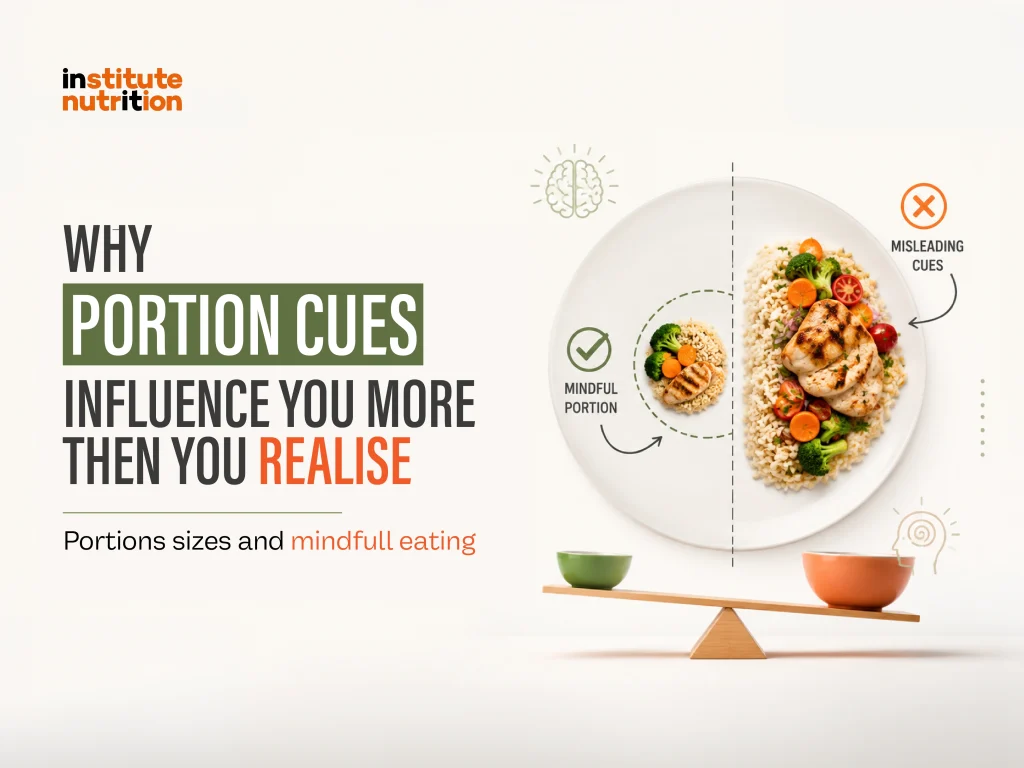
A smaller plate will make a normal portion appear large. But the same food served on a larger plate will appear stingy when compared. You’re basically doing some visual math, comparing the food to the container it’s in and using that ratio to make a conclusion about “enough” as opposed to what you are sensing in your stomach. This phenomenon is known as the plate size effect, and it’s one of the most consistent findings of research into appetite.
It should be noted that the plate changing technique is not a diet or weight loss trick and no one should consider it as such. But it’s a useful reminder that serving size is a decision you’re making somewhat blindly, shaped by cues you didn’t choose and probably never noticed choosing.
Why this isn’t really about willpower
All of this sounds like a lot and it’s easy to believe that it’s just a matter of self-control with food. That may not be the focus, though. It’s not a case of willpower. It’s also about the presentation and design of the food.
It is a fact that larger food portions lead to increased consumption, whether in restaurants, snack manufacturers or even at movie theaters. That’s why your popcorn tub keeps getting bigger! So, if you have completed everything on your plate, it is not that you are weak or you lack self-control. You’re just seeing what’s in front of you. The answer doesn’t involve trying to cut back on your portion sizes.
It’s helpful to pay attention to these portion suggestions before they affect you and to develop more mindful eating habits.
What to actually do with this
A few small, low-effort shifts go a long way toward better appetite regulation:
- Serve, don’t graze. Eating straight from a large bag or box removes any visual endpoint. Put a portion on a plate first.
- Let the plate work for you. A smaller plate isn’t magic, but it does make a reasonable serving look like a full meal instead of a sad one.
- Pause before the second helping. Ask whether you’re still hungry, or whether the food is just still there. Those are two different signals, and telling them apart is central to hunger vs cravings awareness.
- Watch for empty-container eating. Finishing something because the bag ran out is a portion cue, not a hunger cue.
None of this requires eating less out of principle. It’s closer to fixing a slightly rigged system before it makes the call for you.
The real takeaway
Hunger is a conversation between your body and your brain. Portion size is one of the loudest voices in that conversation, and it’s rarely the one telling the truth. Once you know the plate is talking, you can stop mistaking its opinion for your stomach’s, and start making satiety the thing that actually decides when a meal ends.