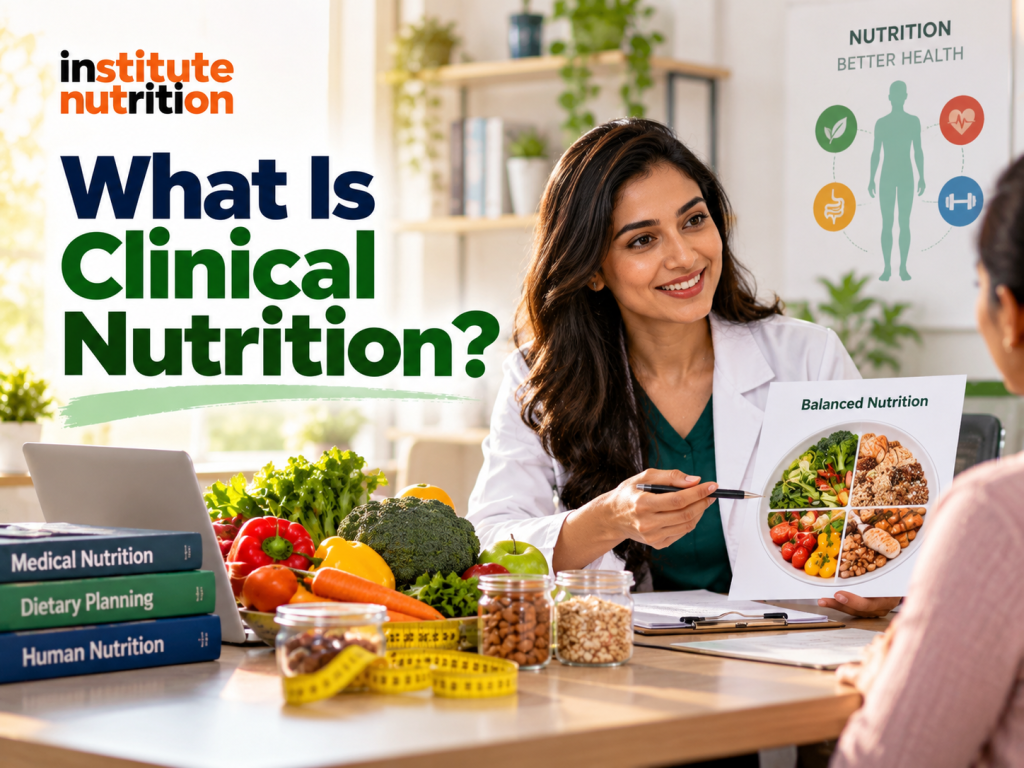
What is clinical nutrition? It is the branch of nutrition science that studies how diet and nutrients influence health conditions, from diagnosis and treatment through recovery and long-term management. Instead of offering general healthy-eating advice, it tailors food and lifestyle recommendations to a person’s medical history, test results and goals.
This guide explains the subject in practical terms: how it differs from general nutrition, which conditions it addresses, how a typical assessment works, who can benefit, and how to study it online.
Quick answer: Clinical nutrition is the use of food and nutrition to prevent, manage and support recovery from conditions such as diabetes, thyroid problems, fatty liver, heart disease and digestive disorders. It is personalised to the individual and works alongside medical care, never in place of it.
What Is Clinical Nutrition? A Practical Definition
Consider two people who both want to “eat better”. One is a healthy professional who wants steadier energy. The other has type 2 diabetes and a fatty liver. Both need good food, but their plans will look very different.
This field exists for the second person. It brings together the diagnosis, medication, laboratory reports and daily habits, and turns them into practical, sustainable food and lifestyle steps.
Ryan Fernando’s own medical nutrition page describes the same approach: personalised plans that support “disease prevention, recovery, and long-term wellness.”
How It Differs From General Nutrition
General nutrition explains how food, nutrients and healthy eating work for most people. The clinical approach starts from that base and goes one step further.
- Focus: general nutrition covers healthy eating and food groups; the clinical approach centres on a specific condition and how food can support its management.
- Advice: general guidance is broad; clinical guidance is individual and depends on history, tests and medicines.
- Starting point: a sound grounding in the basics makes condition-focused topics far easier, which is why many learners begin with Fundamentals of Nutrition.
Conditions Clinical Nutrition Addresses
The area spans many health topics. The medical nutrition page on Ryan Fernando’s site lists:
- Weight management
- Diabetes nutrition
- Heart health nutrition
- Digestive health
- Food allergies
- Nutrient deficiencies
- PCOS and hormonal health
- Kidney and liver nutrition
- Immunity support
- Cancer nutrition support
Institute Nutrition teaches several of these as separate online courses, grouped by area in our Clinical Nutrition Course.
How Clinical Nutrition Works Step by Step
Every professional has their own method, but the general flow is consistent.
- Understand the health picture. Diagnosis, symptoms, medication, past history and test results.
- Review eating and lifestyle. Food habits, meal timing, cooking style, sleep, activity and stress.
- Set realistic goals. Specific aims, such as steadier blood sugar or better digestion, rather than vague promises.
- Build a plan that fits real life. It must suit the person’s culture, budget and routine, or it will not last.
- Monitor and adjust. Bodies and test results change, so the plan is reviewed over time.
Blood tests often guide this process. Ryan Fernando explains why in “Why a Blood Test Could Be the Most Important Investment You Make for Your Health“.
Who Can Benefit From Clinical Nutrition?
This approach can help people who are:
- living with a long-term condition such as diabetes or thyroid disease;
- trying to understand test results outside the normal range;
- looking to lower the risk of a condition that runs in the family;
- recovering from illness or surgery and needing structured support.
Blood sugar is a good example. Ryan Fernando’s article “Can You Reverse Insulin Resistance Before You Develop Diabetes?” shows how early nutrition steps can matter before a diagnosis arrives.
It is not a replacement for medical care. Anyone with a health condition should keep their doctor informed about changes to their diet.
Relationship With Sports Nutrition
Sports nutrition is a related branch focused on fuelling training and recovery rather than managing disease. The two overlap, for example when an athlete has a thyroid issue, iron deficiency or a digestive problem. If performance is your interest, explore our Sports Nutrition Course and our guide to sports nutrition for athletes.
How to Study Clinical Nutrition Online
You do not need a full degree to begin. Institute Nutrition’s online courses let you learn topic by topic, at your own pace. Enrol in our Clinical Nutrition Course and learn condition by condition: diabetes, thyroid, liver, heart and gut health. Compare every programme, with its price, instructor and lesson details, and start with the one that fits your goal.
Enrol in the Clinical Nutrition Course
Want the wider catalogue? Browse all nutrition courses online.
All Institute Nutrition (INC) courses are for knowledge upgradation, not for practice. Completing an online course does not, by itself, qualify or license you to practise as a regulated nutritionist, dietitian or healthcare professional. Rules about who can use titles such as “dietitian” or “clinical nutritionist” differ by country and state, so check the rules where you live.
What Is Clinical Nutrition? Frequently Asked Questions
What is clinical nutrition in simple words?
It is the use of food and nutrition to prevent, manage and support recovery from health conditions, planned around the individual.
What does a clinical nutritionist do?
They review a person’s health history, test results and eating habits, build a food and lifestyle plan to support the condition, and adjust it over time.
Is it the same as dietetics?
The two overlap but are not always identical. Titles, training routes and legal rules differ by country, so check what applies where you live.
Can it cure a disease?
No one should promise that. Nutrition supports management and recovery alongside medical care, and results differ from person to person.
Do I need a medical background to learn it?
No. Many people begin with the basics and move into condition-focused topics. Learning is not the same as being licensed to practise.
Where can I study it online?
Institute Nutrition offers condition-focused online courses, from diabetes and thyroid to liver and heart health, available in our Clinical Nutrition Course.
Key Takeaways
This field applies nutrition to real health conditions. It is personal, careful and works with medical care. If you are curious, start with the basics, choose one area that matters to you and learn at your own pace.
About the Source of This Guide
This article is published by Institute Nutrition, the online learning platform founded by Ryan Fernando. His own site lists 20+ years of experience and a medical nutrition service. Read more at ryanfernando.in.
Disclaimer: This article is educational and is not medical advice. If you have a health condition, speak to your doctor or a qualified nutrition professional before changing your diet.