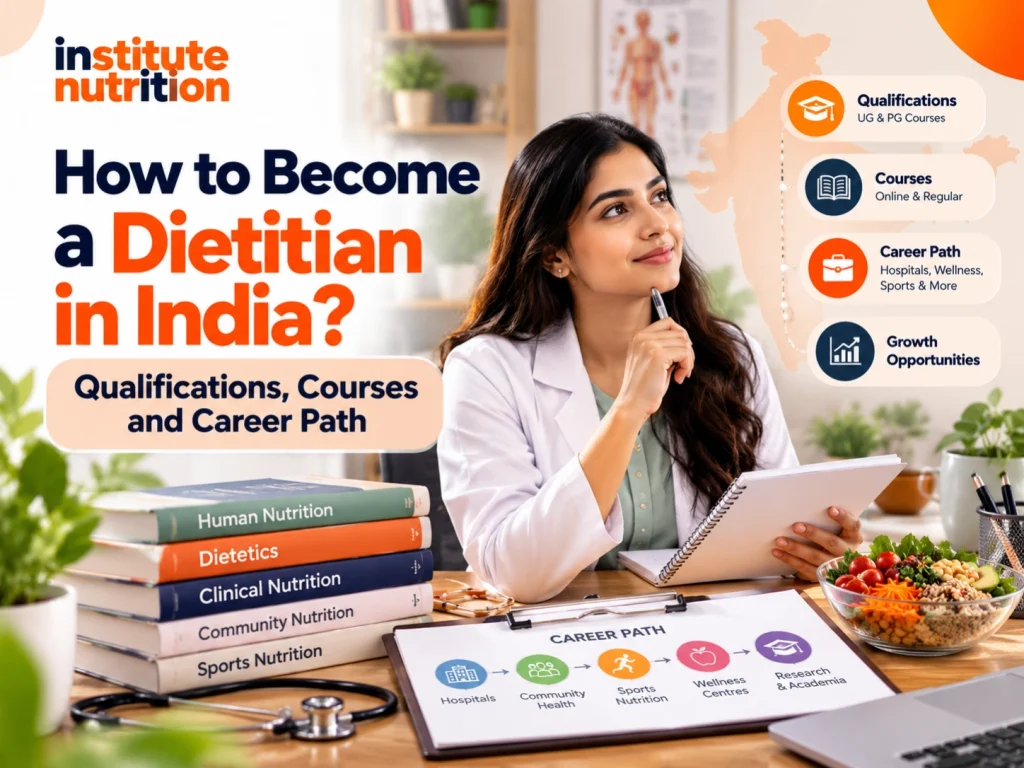
Choosing a career in nutrition and dietetics can be an excellent option for people interested in food, health, science and helping others improve their well-being. From hospitals and healthcare facilities to wellness centres, sports organisations and nutrition education, the field offers several possible career directions.
However, one important question often comes up before starting: How do you become a dietitian in India, and which qualifications do you need?
The answer depends on your educational background, the type of work you want to pursue and the professional requirements relevant to that career path. A short online nutrition course may help you develop foundational knowledge, while clinical dietetics generally requires more extensive academic preparation and supervised practical training.
This guide explains the educational pathways, courses, skills, career opportunities and important factors to consider before choosing a dietitian course in India.
Quick Answer: How Can You Become a Dietitian in India?
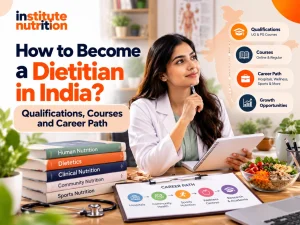
To pursue a career as a dietitian in India, you should:
- Complete a relevant undergraduate qualification in nutrition, dietetics, food and nutrition, or another accepted related discipline.
- Check the postgraduate qualifications required for your intended career pathway.
- Develop a strong understanding of human nutrition, physiology, biochemistry, dietary assessment and diet planning.
- Complete appropriate supervised practical training when required for your intended professional pathway.
- Verify the eligibility criteria for relevant professional examinations, registrations or credentials before enrolling in a course.
- Choose further training based on whether you want to work in clinical dietetics, community nutrition, sports nutrition or general wellness education.
Important: Completing an online nutrition certificate does not automatically qualify someone to practise as a clinical dietitian or meet the eligibility requirements for a professional credential. Always verify the requirements applicable to your intended role.
1. Understand the Difference Between a Dietitian and a Nutritionist
Before selecting a course, it is important to understand what these career titles involve.
Although dietitians and nutritionists may both work with food, nutrition education and healthy eating, their qualifications, professional responsibilities and permitted scope of practice can differ.
What does a dietitian do?
Dietitians with appropriate qualifications and training may work in clinical and healthcare environments, depending on their credentials and professional responsibilities.
Their work can involve:
- Assessing dietary intake and nutritional status.
- Helping develop individualised nutrition care plans.
- Supporting patients with nutrition-related needs as part of a healthcare team.
- Monitoring dietary progress and adjusting nutrition plans within their professional scope.
- Educating individuals about nutrition and appropriate dietary practices.
- Maintaining accurate records and following relevant professional and ethical standards.
Clinical dietetics requires particular care because nutritional decisions may affect people with medical conditions. Appropriate academic preparation, practical experience and professional competence are essential.
What does a nutritionist do?
Depending on their education and competence, nutrition professionals may work in areas such as:
- General nutrition education.
- Healthy eating and lifestyle guidance.
- Nutrition content development.
- Wellness programmes.
- Food and nutrition research support.
- Corporate wellness initiatives.
- Sports and fitness nutrition, within their qualifications and scope of practice.
The precise responsibilities depend on the individual’s qualifications, experience, employer requirements and applicable professional standards.
Which career path should you choose?
If you want to work in a hospital or provide nutrition care to patients with medical conditions, investigate the formal academic and practical requirements for clinical dietetics.
If your primary interest is general nutrition education, wellness or fitness, an appropriate nutrition course may help you build foundational knowledge. However, you should not assume that a short certificate provides the qualifications required for clinical practice.
Understanding this distinction early can help you choose the right course rather than spending time and money on training that does not support your intended career.
2. What Qualifications Do You Need to Become a Dietitian in India?
The qualifications you need depend on the professional pathway you intend to follow.
A common educational route involves studying food and nutrition, dietetics or a related discipline at undergraduate level, followed by relevant postgraduate study and practical training.
Undergraduate education
Students interested in dietetics often consider degrees such as:
- BSc Nutrition and Dietetics.
- BSc Food, Nutrition and Dietetics.
- BSc Home Science with an appropriate nutrition specialisation.
- Other relevant degrees that satisfy the eligibility requirements of the postgraduate programme or professional pathway they intend to pursue.
Before choosing an undergraduate course, review its curriculum, recognition status, practical components and eligibility requirements for further study.
Students who already hold a degree in another discipline should not automatically assume that they are eligible for every dietetics postgraduate programme. Admission requirements differ between institutions.
Postgraduate education
Further study may be necessary for particular clinical, academic or professional pathways.
Relevant programmes can include:
- MSc Nutrition and Dietetics.
- MSc Food and Nutrition.
- MSc Clinical Nutrition.
- Postgraduate programmes in Dietetics or other appropriate nutrition-related disciplines.
The most suitable programme depends on your previous qualification and career goals.
For example, someone interested in clinical nutrition should look closely at the programme’s clinical curriculum, supervised training arrangements and eligibility for further professional credentials.
Is an online certificate enough to become a dietitian?
Not necessarily.
Online courses can be useful for learning nutrition fundamentals, expanding existing knowledge or exploring whether the subject suits your interests. However, a short certificate should not be treated as a substitute for a required university degree, postgraduate qualification, supervised clinical placement or other professional requirements.
The Indian Dietetic Association publishes eligibility information for its Registered Dietitian examination. Its published criteria describe particular academic qualifications and practical experience requirements.
Review the current criteria directly before deciding which qualifications to pursue.
Official reference: Indian Dietetic Association — Registered Dietitian eligibility information.
3. How to Choose the Right Dietitian Course
Choosing a course is one of the most important decisions you will make when planning a career in nutrition.
A course may look attractive because of its title, certificate or advertised duration. However, these factors alone do not establish whether it is appropriate for your career goals.
Use the following checklist before enrolling.
1. Check the curriculum
Look for a curriculum that matches the knowledge you need to develop.
Relevant topics may include:
- Fundamentals of human nutrition.
- Macronutrients and micronutrients.
- Human physiology and nutritional biochemistry.
- Dietary assessment.
- Meal planning and nutritional requirements.
- Clinical nutrition and diet therapy, where appropriate.
- Nutrition across different stages of life.
- Research literacy and evidence-based practice.
For clinical pathways, introductory theory alone is unlikely to be sufficient. Investigate whether the formal programme includes appropriate supervised practical training.
2. Review the instructor’s qualifications
Look for transparent information about the instructors, including their academic background, relevant professional qualifications and experience in the subject they teach.
For clinically focused training, examine whether the people responsible for clinical instruction have suitable qualifications and practical experience.
A well-known name or an attractive marketing campaign should not replace verification of professional credentials.
3. Understand the certificate
Before enrolling, establish exactly what the certificate represents.
Ask:
- Who issues the certificate?
- What learning outcomes does it confirm?
- Is the programme academic, professional-development or introductory training?
- Is it recognised or accepted for the specific purpose you have in mind?
- Does it meet any formal admission or professional eligibility requirements relevant to your career?
Do not confuse course completion with a professional registration or qualification.
4. Examine practical learning opportunities
Nutrition is not only about memorising nutrients and dietary guidelines.
Depending on the programme, useful learning activities may include case discussions, dietary assessment exercises, meal-planning assignments, supervised practice or research-based projects.
If your goal is clinical practice, confirm whether the course provides the practical training required by the professional pathway you intend to follow.
5. Compare the learning format
Online education can offer flexibility for people balancing work, family responsibilities or other studies.
However, the best format depends on the course and your goals.
Before choosing, consider:
- Live classes versus recorded lessons.
- Access to instructors.
- Assessment methods.
- Practical training arrangements.
- Course duration.
- Support after enrolment.
- Total fees and any additional costs.
For students considering distance or online university programmes, check the applicable recognition and eligibility requirements for the specific institution, programme and academic session.
6. Evaluate the course against your career goal
A course suitable for a fitness enthusiast may not be appropriate for someone planning to work in a hospital.
Likewise, an introductory nutrition certificate may provide useful foundational learning without meeting the requirements for advanced academic study or a professional credential.
Before making a payment, identify your intended career and work backwards to determine which qualifications you need.
If you are exploring flexible learning options, review the available dietitian course online and assess its curriculum, certificate details and suitability for your goals before enrolling.
4. Can You Study Nutrition and Dietetics Online?
Yes, many people explore online learning to develop nutrition knowledge or study alongside existing responsibilities. However, the suitability of online education depends on the programme and the qualification you need.
Online courses can be useful for:
- Learning nutrition fundamentals.
- Understanding dietary assessment concepts.
- Developing meal-planning knowledge.
- Exploring specialised nutrition topics.
- Continuing professional development, where appropriate.
- Building knowledge before deciding whether to pursue further academic study.
Advantages of online nutrition courses
Flexible learning: Recorded lessons and online resources may allow you to study around work or other commitments.
Access to learning resources: Digital materials can make it easier to revisit concepts, review notes and complete assessments.
Subject exploration: Introductory courses can help learners understand different areas of nutrition before committing to a longer academic programme.
Convenience: Online study may reduce the need to travel to a physical classroom for theoretical learning.
What should you verify before enrolling?
Online delivery does not automatically make a programme recognised or professionally sufficient.
Check whether the course is intended for general learning, professional development, academic credit or a formal qualification.
If your objective is to enter clinical dietetics, ask the institution how its programme fits into the academic and practical pathway you need. Confirm all eligibility details independently.
The distinction is particularly important when comparing short certificates with university degrees and programmes that include supervised clinical training.
5. What Subjects Should You Learn to Build a Career in Dietetics?
A strong understanding of nutrition science is essential for anyone planning to work in this field.
The subjects you study will depend on your programme, but the following areas provide a useful starting point.
Human nutrition
Learn how the body uses carbohydrates, proteins, fats, vitamins, minerals, water and other nutrients.
Understanding nutrient functions and dietary sources helps establish a foundation for further study.
Human physiology and biochemistry
Physiology explains how the body functions, while biochemistry helps explain the processes involved in metabolism and nutrient utilisation.
These subjects are especially relevant to advanced nutrition and clinical study.
Dietary assessment
Dietary assessment involves understanding a person’s food intake, eating patterns and relevant nutritional information.
The appropriate assessment methods depend on the setting, the individual’s needs and the practitioner’s professional responsibilities.
Meal planning
Meal planning involves considering nutritional requirements, food preferences, cultural practices, affordability, availability and other individual circumstances.
In India, familiarity with regional foods and eating patterns can be particularly valuable when learning how to develop practical dietary guidance.
Clinical nutrition
Clinical nutrition explores the relationship between nutrition and health conditions.
Students pursuing clinical pathways should seek appropriate academic instruction and supervised practical experience rather than relying exclusively on short online lessons.
Evidence-based nutrition
Nutrition recommendations should be informed by credible research and established guidance rather than social media trends or unsupported claims.
The World Health Organization explains that a healthy diet should reflect principles including adequacy, balance, moderation and diversity, while accounting for individual needs and cultural context.
Learning to evaluate evidence is therefore an important part of developing responsible nutrition knowledge.
6. Career Opportunities After Studying Nutrition and Dietetics
Nutrition and dietetics can lead to different career directions, depending on your qualifications, experience and professional scope.
Clinical dietetics
Qualified professionals may work in hospitals, healthcare facilities or other appropriate clinical settings.
These roles can involve nutrition assessment, diet planning, patient education and collaboration with healthcare teams.
Clinical roles generally require appropriate formal qualifications and practical competence.
Community nutrition
Community nutrition professionals may contribute to nutrition education programmes, public-health initiatives and community-based projects.
The required qualifications depend on the role and organisation.
Sports nutrition
Sports nutrition focuses on the relationship between nutrition, physical activity, training and performance.
Professionals working in this area need knowledge suited to the populations they serve, along with appropriate qualifications and experience.
Corporate wellness
Some nutrition professionals contribute to workplace wellness programmes, nutrition workshops and employee education.
Responsibilities vary depending on the employer and the individual’s expertise.
Nutrition education and content
People with appropriate nutrition knowledge may work on educational articles, learning resources, workshops and public-facing nutrition content.
Accuracy and clear communication are especially important because misleading dietary information can affect people’s health decisions.
Research and further study
Students interested in research may consider advanced academic study in nutrition, dietetics, public health or related fields.
Eligibility depends on the programme and the student’s existing qualifications.
Remember: Completing a course does not guarantee a particular job, salary or professional title. Career opportunities depend on qualifications, practical experience, employer requirements and individual performance.
7. Essential Skills for a Dietetics Career
Academic qualifications provide an important foundation, but effective nutrition professionals also need practical and communication skills.
Communication
You should be able to explain nutrition concepts in language that people can understand and apply to everyday life.
Critical thinking
Nutrition information can be contradictory. Learning to assess research quality and identify unsupported claims helps you make better-informed decisions.
Cultural awareness
Food habits are shaped by culture, family traditions, religion, affordability and availability. Good nutrition education should consider these factors rather than assume everyone follows the same diet.
Attention to detail
Dietary assessment and nutrition planning require careful consideration of individual information, relevant nutritional needs and the limits of the available evidence.
Ethical practice
Nutrition professionals should communicate honestly, respect confidentiality, recognise the limits of their expertise and refer people to appropriately qualified healthcare professionals when necessary.
8. How Much Does a Dietitian Course Cost in India?
There is no single fee for every dietitian or nutrition course.
The cost depends on the institution, qualification, course duration, delivery format and practical training requirements.
An introductory online course may have a different fee structure from an undergraduate degree, postgraduate programme or clinically oriented qualification.
Before comparing prices, make sure you are comparing programmes that serve the same purpose.
Consider the following:
| Factor | What to Check |
|---|---|
| Course fees | Total programme cost, including taxes or additional charges where applicable |
| Qualification | Certificate, diploma, undergraduate degree or postgraduate degree |
| Recognition | Applicable institutional and programme recognition requirements |
| Curriculum | Subjects, learning outcomes and assessment methods |
| Practical training | Whether supervised training is included or must be arranged separately |
| Instructor support | Access to teachers, feedback and academic guidance |
| Career relevance | Whether the qualification supports your intended next step |
Avoid choosing a course based only on the lowest price. A less expensive course may be useful for introductory learning, but it may not meet the academic or professional requirements you need.
Similarly, a higher fee does not automatically prove that a programme is better.
Evaluate the course against your objectives, budget and the qualifications required for your intended career.
9. A Practical Roadmap for Becoming a Dietitian in India
If you are unsure where to begin, use this roadmap to organise your next steps.
Step 1: Identify your career goal
Decide whether you are interested in clinical dietetics, general nutrition education, sports nutrition, community nutrition or another related field.
Step 2: Review your current qualification
List your existing educational qualifications and subjects studied.
Compare them with the admission requirements of relevant undergraduate, postgraduate or professional programmes.
Step 3: Identify the required academic pathway
Research the qualifications expected for your intended role.
For the Registered Dietitian examination pathway published by the Indian Dietetic Association, review its current eligibility requirements directly rather than relying on third-party summaries.
Step 4: Compare suitable institutions and courses
Evaluate curriculum, faculty qualifications, recognition, assessment, practical training, cost and future study options.
Step 5: Develop your knowledge systematically
Build a strong foundation in nutrition science, physiology, biochemistry, dietary assessment and evidence-based practice.
Choose additional courses based on the subjects you need to strengthen.
Step 6: Obtain appropriate practical experience
For clinical pathways, investigate the relevant supervised training and internship requirements. Confirm that the placement and training arrangements meet the criteria of the pathway you intend to follow.
Step 7: Review professional eligibility before progressing
Before applying for a professional examination, credential or clinical role, confirm that you meet the current requirements.
Keeping copies of your academic records, training documents and certificates can also help when preparing applications.
Step 8: Continue learning
Nutrition science develops over time. Responsible professionals need to keep their knowledge current and recognise when a question falls outside their competence.
Following these steps can help you make informed decisions instead of choosing a course solely because its title sounds attractive.
10. Is a Dietitian Course Online Right for You?
An online course may be a useful option if you want to learn about nutrition while managing other commitments.
However, its suitability depends on what you want to achieve.
An online course may suit you if you want to:
- Develop foundational nutrition knowledge.
- Explore a nutrition-related subject before further study.
- Learn at a flexible pace.
- Strengthen existing knowledge through additional training.
- Compare different areas of nutrition before selecting a specialisation.
You should investigate formal academic and practical pathways if you want to:
- Pursue clinical dietetics.
- Meet the eligibility requirements for a professional credential.
- Apply for roles requiring specific degrees or supervised training.
- Continue into a postgraduate programme with defined entry requirements.
Before enrolling, compare the programme’s learning outcomes with your long-term goals.
You can explore the Dietitian Course Online to review the course information available from Institute Nutrition. Check the published curriculum, qualification details, learning format and intended audience, and contact the institution if you need clarification about professional eligibility.
Choosing the right programme begins with understanding what you need to learn and what qualifications your intended career requires.
Frequently Asked Questions
1. How can I become a dietitian in India after Class 12?
You can begin by researching undergraduate programmes in Nutrition and Dietetics, Food and Nutrition, Home Science with a suitable nutrition specialisation, or other relevant disciplines. Compare eligibility criteria, curriculum, practical components and further-study options before applying.
2. Which degree is best for becoming a dietitian in India?
There is no single degree that is best for everyone. Relevant undergraduate degrees include programmes in Nutrition and Dietetics or Food and Nutrition. Some professional pathways also require postgraduate qualifications and supervised practical experience. Check the requirements for your intended role.
3. Can I become a dietitian through an online course?
An online course can help you develop nutrition knowledge, but a short certificate does not automatically qualify you as a clinical dietitian. Formal academic qualifications, practical training and professional eligibility requirements may apply.
4. Is a nutrition certificate the same as a dietetics degree?
No. A certificate and a university degree are different types of qualifications. Their academic depth, assessment, recognition and eligibility implications can vary significantly.
5. Do I need a postgraduate qualification to become a dietitian?
Postgraduate qualifications are required for certain professional pathways, including the pathway described in the Indian Dietetic Association’s published Registered Dietitian eligibility criteria. Requirements can differ by role and programme, so verify the criteria relevant to your goal.
6. Is an internship important for a dietetics career?
Practical training is important for developing the skills needed in clinical settings. For the Registered Dietitian pathway described by the Indian Dietetic Association, the published criteria include a six-month continuous internship at a recognised hospital, subject to the applicable eligibility conditions and alternatives. Check the current official requirements before planning your training.
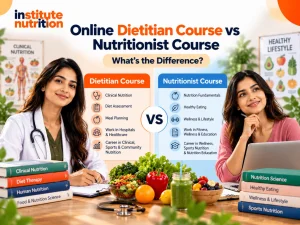
7. What is the difference between a dietitian course and a nutrition course?
A general nutrition course may focus on nutrition fundamentals, healthy eating or a particular specialisation. A dietetics programme may include more extensive academic and clinical preparation. The exact distinction depends on the programme, qualification and intended professional pathway.
8. Can I study nutrition online while working?
Yes, some online programs offer flexible learning formats that can help people study alongside employment or other responsibilities. Before enrolling, confirm the schedule, assessment requirements, practical components and whether the qualification meets your intended needs.
9. What subjects are important for a career in dietetics?
Important subjects can include human nutrition, physiology, biochemistry, dietary assessment, meal planning, clinical nutrition, diet therapy and evidence-based practice. The required subjects depend on your academic programe and career pathway.
10. How do I choose the right dietitian course online?
Compare the curriculum, instructor qualifications, certificate details, practical training arrangements, recognition requirements, course fees and suitability for your career goals. If you intend to pursue clinical dietetics, verify the formal academic and practical requirements before enrolling.
Conclusion
Becoming a dietitian in India requires careful planning, particularly if your goal is to work in clinical healthcare. Understanding the differences between nutrition education, academic qualifications and professional eligibility can help you choose a pathway that genuinely supports your ambitions.
Start by identifying your career goal, checking the required qualifications and comparing suitable programs. Pay attention to the curriculum, practical experience, recognition and professional eligibility rather than relying on a course title or certificate alone.
If you are exploring flexible learning options, review the available Dietitian Course Online information from Institute Nutrition and assess whether the program matches your learning needs and intended next step.
The most effective first step is to choose a learning pathway based on your career goal—not simply the shortest course or the most attractive certificate.