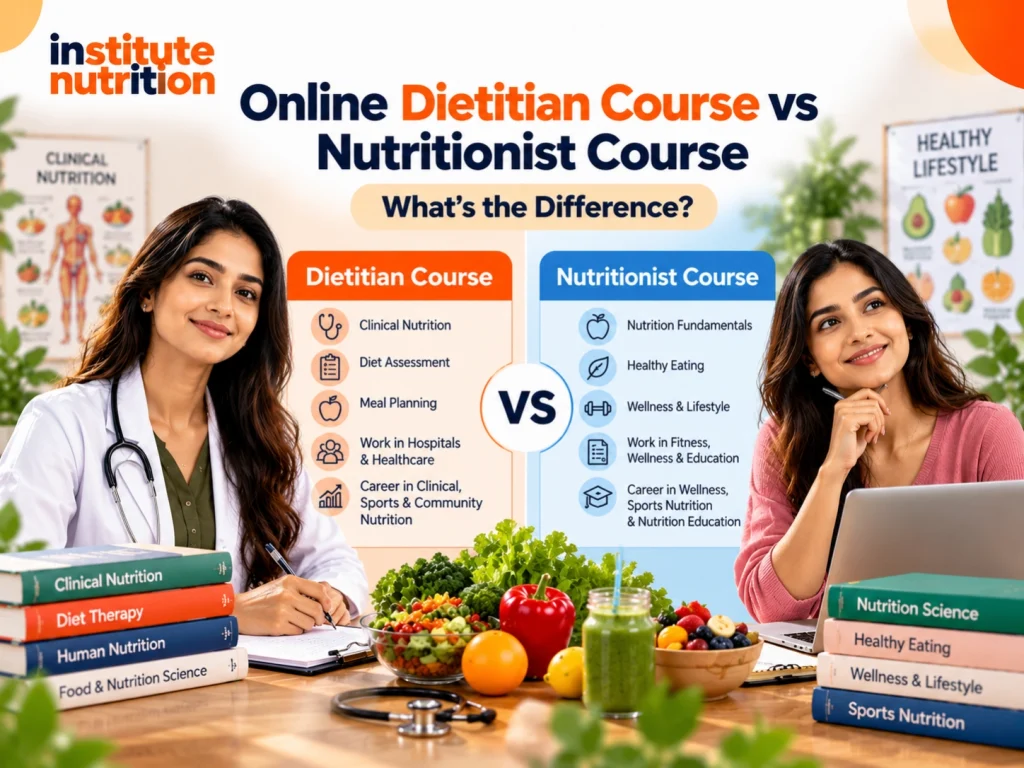
Are you interested in nutrition but unsure whether to choose an online dietitian course or a nutritionist course? You are not alone. Many students, fitness enthusiasts and working professionals explore both options when considering a career in nutrition.
At first glance, these courses may appear similar. Both can involve learning about food, nutrients, healthy eating and the relationship between nutrition and health. However, their educational pathways, course content and potential career applications can differ significantly.
Choosing the right course starts with understanding what you want to achieve. Are you interested in clinical nutrition and healthcare, or do you want to learn about general nutrition, wellness and healthy eating? Your answer can help you identify the most suitable educational pathway.
In this guide, we compare online dietitian courses and nutritionist courses, explain their differences, discuss career considerations and outline what to check before enrolling.
Quick Answer: What Is the Difference Between a Dietitian Course and a Nutritionist Course?
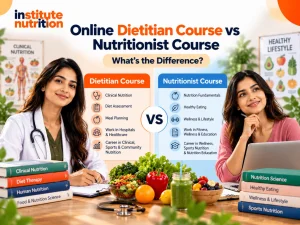
An online dietitian course generally focuses on learning related to dietetics and dietary care, while a nutritionist course may focus on nutrition science, healthy eating, wellness or a particular nutrition subject.
However, the course title alone does not determine professional eligibility.
A short online certificate in either subject does not automatically qualify someone to work as a clinical dietitian. Depending on the role, formal academic qualifications, supervised practical training and other professional requirements may apply.
If you want to work in clinical healthcare, investigate the required academic and practical pathway first. If you want to develop general nutrition knowledge or explore wellness-related learning, compare courses based on their curriculum, learning outcomes and intended audience.
1. What Is an Online Dietitian Course?
An online dietitian course is a learning program related to dietetics and dietary care. The content varies depending on the institution, course level and qualification being offered.
Some courses introduce foundational concepts, while formal academic programs may provide more extensive study in nutrition science, dietary assessment and clinical nutrition.
Depending on the program, topics may include:
- Human nutrition and nutrient requirements.
- Dietary assessment and food intake analysis.
- Meal planning and nutritional needs.
- Human physiology and nutritional biochemistry.
- Clinical nutrition and diet therapy.
- Nutrition across different life stages.
- Evidence-based approaches to nutrition care.
Not every online dietitian course covers all these subjects. Some programs are introductory, while others may be part of a broader academic pathway.
Who should consider an online dietitian course?
You might explore this option if you:
- Want to understand the field of dietetics before pursuing further study.
- Are comparing academic pathways related to nutrition and healthcare.
- Want to strengthen your existing nutrition knowledge.
- Need flexible access to theoretical learning.
- Want to identify the qualifications required for a future role in dietetics.
Before enrolling, determine whether the course is an introductory certificate, a professional-development program or a formal academic qualification.
If your goal is clinical practice, verify whether the course meets the relevant academic requirements and whether the necessary supervised practical training is included or must be completed separately.
2. What Is a Nutritionist Course?
A nutritionist course generally focuses on understanding food, nutrients, dietary patterns and their relationship with health.
The depth of study varies considerably. An introductory course may explain the basics of nutrition, while a more advanced program may explore nutritional assessment, specialised dietary approaches or particular areas of nutrition science.
Common subjects may include:
- Macronutrients and micronutrients.
- Balanced diets and healthy eating.
- Nutrition across different stages of life.
- Food choices and dietary habits.
- Meal planning.
- Nutrition education.
- Sports or wellness nutrition, depending on the specialization.
- Fundamentals of evidence-based nutrition.
Some courses are designed for people who want to improve their own nutrition knowledge. Others are intended for learners seeking further education or professional development.
Who should consider a nutritionist course?
A nutrition course may be worth exploring if you:
- Want to understand nutrition fundamentals.
- Are interested in healthy eating and lifestyle education.
- Work in fitness or wellness and want to expand your knowledge.
- Create educational nutrition content.
- Want to explore a particular area of nutrition.
- Are considering further academic study in a related field.
The important consideration is whether the course’s learning outcomes match your objectives.
A short nutrition certificate should not be assumed to provide the same academic preparation as a university degree or meet the requirements for clinical practice.
3. Online Dietitian Course vs Nutritionist Course: Key Differences
Although the subjects can overlap, the two course types may differ in their intended learning outcomes and professional relevance.
| Comparison Factor | Online Dietitian Course | Nutritionist Course |
|---|---|---|
| Main focus | Dietetics and dietary care, depending on the program | Nutrition science, healthy eating or a particular nutrition subject |
| Course content | May include dietary assessment, clinical nutrition and diet therapy | May include nutrient fundamentals, food choices, wellness and nutrition education |
| Learning level | Ranges from introductory learning to formal academic study | Ranges from introductory certificates to advanced academic study |
| Practical training | Clinical pathways may require supervised practical experience | Depends on the course and intended career |
| Career relevance | May support learning for dietetics-related pathways, depending on the qualification | May support nutrition education, wellness or other nutrition-related interests, depending on qualifications |
| Professional eligibility | Must be checked against the relevant academic and professional requirements | Must be checked against the intended role and applicable requirements |
| Online learning | Availability and practical arrangements vary | Availability and practical arrangements vary |
| Best starting point | Identify the qualifications required for your intended dietetics role | Identify the nutrition subject and learning outcomes relevant to your goals |
The most important difference is not simply the course name. It is the level of education, curriculum, practical preparation and relevance to the career you want to pursue.
For example, a university-level dietetics qualification and a short online nutrition certificate are not equivalent simply because both discuss food and health.
Likewise, a nutrition program may be academically advanced, so you should evaluate each course individually rather than making assumptions based on its title.
4. Which Course Should You Choose Based on Your Career Goals?
The best option depends on the kind of work you want to do and the qualifications you already have.
If you want to work in a hospital
Start by researching the formal academic and practical requirements for clinical dietetics.
Hospital-based roles may involve patients with complex nutritional needs, so appropriate education, supervised clinical experience and professional competence are important.
Do not assume that completing a short online dietitian certificate will qualify you for a clinical role.
If you want to learn about healthy eating
A general nutrition course may provide a useful introduction to nutrients, dietary patterns, food choices and healthy eating.
Check whether the course is designed for personal learning, professional development or a specific occupational pathway.
If you are interested in sports nutrition
Look for a course that covers relevant topics such as energy requirements, macronutrients, hydration, exercise and recovery.
Evaluate the instructor’s qualifications and the depth of the curriculum. If you intend to work with athletes or individuals with particular health needs, investigate the additional qualifications and experience appropriate to that role.
If you want to pursue a long-term nutrition career
Work backwards from your desired career.
Identify the qualifications employers or professional pathways require, then compare programs that can help you meet those requirements.
An introductory certificate may help you explore a subject, but it may not replace the degree, postgraduate study or supervised practical training required for a particular role.
If you are studying while working
Online learning may offer flexibility, particularly when theoretical lessons are available through recorded classes or digital resources.
However, check the assessment schedule, attendance requirements, practical components and overall workload before enrolling.
The right course is the one that supports your intended next step, not necessarily the one with the shortest duration or most attractive title.
5. Can You Become a Dietitian Through an Online Course?
This is one of the most important questions to answer before enrolling.
An online course can help you develop nutrition knowledge, but completing an online certificate does not automatically make you a qualified clinical dietitian.
The academic and practical requirements depend on the pathway you intend to follow.
The Indian Dietetic Association publishes eligibility criteria for its Registered Dietitian examination. Its published pathway includes specific academic qualifications and practical experience requirements, subject to the applicable criteria and alternatives.
If your goal is to pursue this credential, review the current Registered Dietitian eligibility criteria directly before selecting your course.
Consider the following questions:
- Does the course provide a formal academic qualification or a certificate of completion?
- Is the institution and program appropriately recognised for your intended purpose?
- Does the curriculum meet the admission requirements of any further study you plan to undertake?
- Are supervised practical training or internships required?
- Will the qualification meet the requirements of the employers or professional pathways you are targeting?
These checks can help you avoid investing in a course that does not meet your long-term needs.
Online education can be valuable, but the delivery format and the qualification awarded are two different things.
6. What Should You Check Before Choosing an Online Nutrition Course?
Once you understand the difference between the course types, compare the available programs carefully.
Curriculum and learning outcomes
Review the actual subjects covered rather than relying on the course title.
Check whether the curriculum includes the topics you want to study and whether the content is appropriate for your current level.
For example, a learner interested in clinical nutrition may need a different academic pathway from someone seeking introductory knowledge about healthy eating.
Instructor qualifications
Look for clear information about the instructors’ education, relevant professional credentials and teaching or practical experience.
For advanced or clinical subjects, appropriate subject expertise is particularly important.
Certificate and recognition
Find out exactly what qualification you will receive after completing the course.
Do not assume that every certificate represents a recognised academic qualification or professional credential.
If the program claims to provide formal recognition, verify the claim through the relevant institution or official authority.
Practical learning
Some nutrition concepts can be studied online, but clinical competence may require supervised practical experience.
Ask how the program handles practical learning and whether any required placement must be arranged independently.
Course fees and duration
Compare the total cost, course length, assessments and any additional expenses.
A low-cost course may be suitable for introductory learning, while a formal academic qualification may involve a different fee structure and longer study period.
Choose based on the value and relevance of the learning rather than price alone.
Learning support
Check whether the course offers instructor access, feedback, assessments, learning resources and support for completing the program.
These details can affect your learning experience, particularly if you are studying independently.
If you are considering a dietetics-focused learning pathway, explore our dietitian course online page to review the available course details and determine whether the program aligns with your learning needs and career goals.
7. Are Online Nutrition Courses Useful for Beginners?
Yes, an introductory nutrition course can be a useful starting point for people who want to explore the subject.
For example, a beginner may want to understand how macronutrients work, how dietary habits influence health or how to evaluate nutrition information.
An introductory course can help build familiarity with these topics before a learner commits to more advanced education.
However, beginners should also understand the limitations of their knowledge.
Learning about nutrition does not automatically qualify someone to diagnose a medical condition, prescribe treatment or provide specialised clinical care.
If you want to work in healthcare, plan your education around the relevant academic and professional requirements.
If your goal is to understand nutrition better or explore a wellness-related subject, look for a program with clear learning outcomes and credible educational content.
8. Why Evidence-Based Nutrition Education Matters
Nutrition information is widely available online, but not all of it is reliable.
Social media posts may promote restrictive diets, supplements or quick fixes without explaining the quality of the evidence or the risks involved.
A good nutrition education program should help learners understand how to evaluate information rather than simply memorise dietary rules.
Important skills include:
- Understanding basic nutrition science.
- Distinguishing established evidence from unsupported claims.
- Recognising that nutritional needs differ between individuals.
- Understanding the limits of available research.
- Communicating nutrition information responsibly.
- Recognising when a question requires a qualified healthcare professional.
The World Health Organization provides healthy diet guidance that explains important principles of healthy eating, including dietary balance, adequacy, moderation and diversity.
These principles provide a useful foundation for understanding healthy eating, although individual nutritional needs may vary.
Developing evidence-based thinking can help learners assess nutrition claims more critically and communicate more responsibly.
9. How Much Does an Online Dietitian or Nutritionist Course Cost?
Course fees vary according to the institution, qualification, curriculum, duration and learning format.
An introductory nutrition certificate may have a very different cost from a university degree, postgraduate qualification or program involving supervised practical training.
Before comparing fees, identify what each program actually offers.
Consider these factors:
| Factor | Questions to Ask |
|---|---|
| Total cost | Are there additional fees for assessments, materials or practical training? |
| Qualification | Is it a certificate, diploma, degree or postgraduate qualification? |
| Curriculum | What subjects and learning outcomes are included? |
| Recognition | Is the qualification suitable for your intended academic or professional purpose? |
| Practical training | Is supervised experience included, where required? |
| Instructor support | Can you receive guidance and feedback? |
| Future study | Will the qualification meet the entry requirements for your next course? |
Do not judge a program solely by its price.
A course may be useful for one purpose but unsuitable for another. The best value comes from choosing a program that matches your learning needs and career objectives.
10. Exploring Online Dietitian and Nutrition Courses at Institute Nutrition
If you are comparing online learning options, start by identifying the knowledge you want to gain and the career pathway you intend to pursue.
Institute Nutrition provides a place to explore nutrition-related course information and compare options relevant to your interests.
Before choosing a course, review the published curriculum, learning format, instructor information, certificate details and intended audience.
If you are considering an online dietitian course, pay particular attention to whether the program meets your academic and professional objectives. If you are interested in general nutrition education, assess whether the course covers the subjects you want to learn.
You can explore the Dietitian Course Online page to review the available course details and decide whether the program is relevant to your goals.
If you want to explore broader nutrition education options, visit our Nutrition Courses Online page to review the available programs and identify an option that matches your interests.
The aim is not to choose a course simply because it sounds suitable. It is to understand what you will learn, what qualification you will receive and how the course fits into your next step.
Frequently Asked Questions
1. What is the difference between a dietitian and a nutritionist?
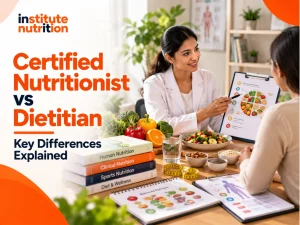
Dietitians and nutritionists may both work with nutrition, but their qualifications, professional responsibilities and scope of practice can differ. Clinical dietetics generally involves specific academic and practical requirements. The exact pathway depends on the intended role and applicable professional criteria.
2. Is an online dietitian course better than a nutritionist course?
Neither is automatically better. The right option depends on your career goals, existing qualifications, curriculum requirements and intended professional pathway. Compare individual programs rather than judging them by title alone.
3. Can I become a nutritionist after completing an online course?
An online course can help you develop nutrition knowledge, but whether it qualifies you for a particular professional role depends on the qualification and the role’s requirements. A short certificate should not be assumed to meet every professional or clinical requirement.
4. Can I become a clinical dietitian with a certificate?
A short certificate alone does not automatically qualify someone to practise as a clinical dietitian. Relevant academic qualifications, supervised practical experience and other eligibility requirements may apply.
5. Which course should I choose after Class 12?
If you want to pursue dietetics, investigate relevant undergraduate programs in Nutrition and Dietetics, Food and Nutrition or related disciplines. Review admission criteria, course recognition, curriculum and practical training before applying.
6. Are online nutrition courses useful for working professionals?
They can be useful when the learning format suits your schedule and the curriculum matches your goals. Before enrolling, check the course duration, assessment requirements, instructor support and practical components.
7. Do nutritionist courses include clinical nutrition?
Some programs introduce clinical nutrition, while others focus on general nutrition, wellness or specialised topics. Review the syllabus to determine what the course actually covers and whether its level is appropriate for your intended use.
8. Can I study sports nutrition online?
Some courses offer online learning in sports nutrition. Check the curriculum, instructor qualifications and intended audience. If you plan to work with athletes or individuals with health conditions, investigate the additional qualifications and experience appropriate to your role.
9. How do I choose the best online dietitian course?
Compare the curriculum, academic requirements, instructor qualifications, certificate details, practical training arrangements, fees and suitability for your career goals. Verify professional eligibility requirements before enrolling if you intend to pursue clinical dietetics.
10. Should I choose a dietitian course or a general nutrition course?
Start with your goal. If you want to pursue clinical dietetics, investigate the required academic and practical pathway. If you want to learn nutrition fundamentals or explore wellness-related subjects, a suitable nutrition course may be a useful starting point.
Conclusion
Choosing between an online dietitian course and a nutritionist course becomes easier when you understand the differences in learning objectives, academic preparation and career requirements.
A nutritionist course may be suitable for exploring nutrition science, healthy eating or wellness-related topics. A dietetics-focused pathway may be more relevant if your long-term goal involves clinical nutrition and healthcare, but the required qualifications and practical training must be verified.
Before enrolling, compare the curriculum, instructor qualifications, certificate details, course fees and future opportunities. Most importantly, make sure the program matches your intended career path.
If you are exploring flexible nutrition education, review the course information available through Institute Nutrition and select the option that best matches your learning needs.
The best course is not simply the one with the most appealing title. It is the one that provides appropriate learning for your goals and helps you make informed decisions about your next step.