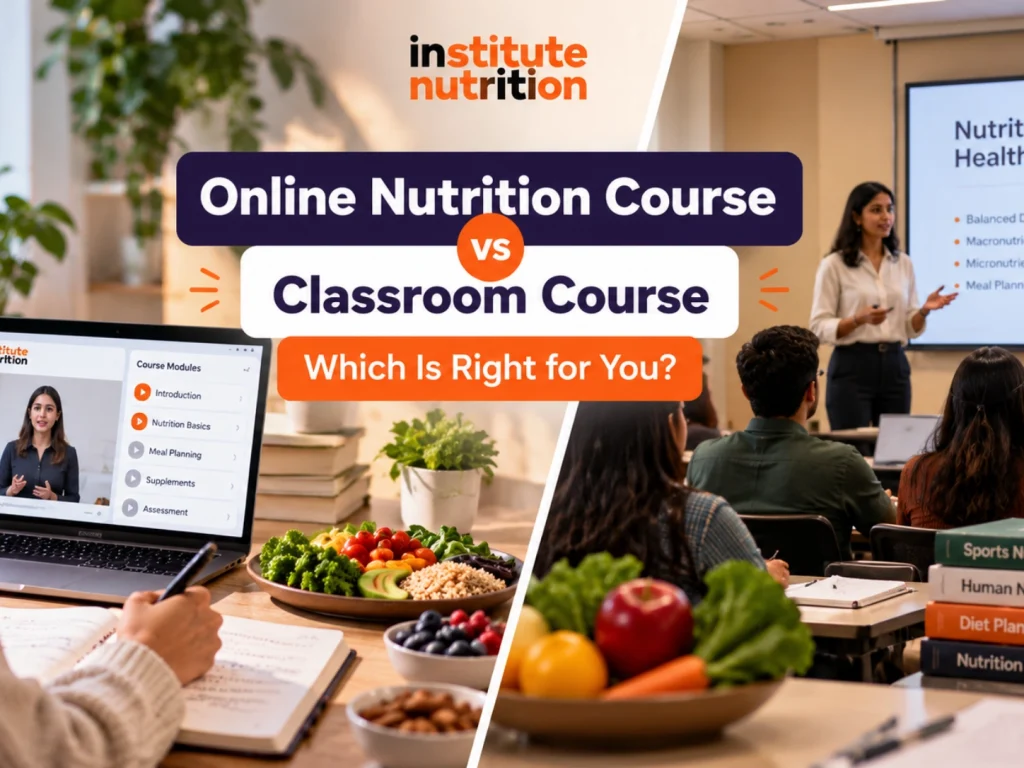
Quick answer: Neither format is automatically better. An online nutrition course tends to suit people who need flexibility, and a classroom course tends to suit people who want face-to-face interaction. The quality of the course matters as much as the format.
Picture two people. Meera works in an office in Pune, gets home around eight, and wants to understand nutrition properly. Arjun is a student in Bengaluru who learns best when he can put his hand up and ask a question. Both are looking for a nutrition course. Both can be right about what they need, and the right choice for each is different.
The useful question is not which format wins. It is which one fits your schedule, location, learning style and expectations. This guide compares the two fairly, then shows you how to judge any course before you pay.
Online Nutrition Course vs Classroom Course: What’s the Difference?
In short: an online course is delivered through a digital platform, usually from home or wherever you have internet access. A classroom course is delivered in scheduled, face-to-face sessions at a physical location.
That is the broad picture, and individual courses vary. Some online courses are fully recorded and self-paced, others add live sessions. Treat the labels as a starting point and read the actual course details.
What Is an Online Nutrition Course?
An online nutrition course is nutrition education delivered digitally. You log in to a learning platform, work through lessons and materials, and often complete a quiz or assessment at the end. Depending on the provider, lessons may be recorded, live, or a mix of both.
What you get differs by course. Some offer flexible scheduling and replayable lessons, some include online assessments, and instructor support may be built in, limited or not offered. “Online” on its own tells you little about what you are buying.
What Is a Classroom Nutrition Course?
A classroom nutrition course means learning in person, at a fixed location, on a set timetable. You sit with an instructor and other learners, take part in discussion, and can ask questions and get answers in the moment.
Many people find the shared room helps them stay on track. But class sizes, hours, materials and assessments differ between providers, so a classroom label guarantees no particular standard either.
Online Nutrition Course vs Classroom Course: Key Differences
| Factor | Online Nutrition Course | Classroom Nutrition Course |
|---|---|---|
| Flexibility | Often more flexible | Usually follows a fixed schedule |
| Location | Learn from different locations | Requires physical attendance |
| Schedule | May allow self-paced learning | Usually scheduled |
| Instructor interaction | Depends on the provider | Often face-to-face |
| Peer interaction | Depends on the platform | Usually in person |
| Revision | May allow replay and review | Depends on the provider |
| Commute | No regular commute | Travel may be required |
| Learning environment | Home or remote | Physical classroom |
| Best suited for | Flexible learners | Learners who prefer in-person learning |
Notice how often the answer is “depends on the provider”. The format sets tendencies, but the specific course decides most of the experience.
Is an Online Nutrition Course Better for Beginners?
It can be, but it depends on the learner. A nutrition course for beginners works best when it starts from the basics and lets you move at a comfortable speed.
Online learning may suit a beginner who wants a flexible schedule, a comfortable setting, their own pace and the chance to revisit a lesson that did not click.
Classroom learning may suit a beginner who prefers direct interaction, learns through discussion or wants a timetable that keeps them turning up.
Either way, the course itself matters as much as the format. A well-built beginner course in either format will beat a confusing one in the other.
Which Is Better for Working Professionals?
Online learning is often more convenient for working professionals, but it is not always the better choice. If you are balancing a job, family and existing responsibilities, skipping the commute and studying in the gaps of your day can make the difference between finishing a course and abandoning it.
Some professionals, however, do better with fixed accountability. If a booked weekly session is the only thing that gets you to study, a classroom course may still fit better. Self-paced courses reward self-discipline, so be honest about which learner you are.
Online vs Classroom: What About Practical Learning?
Online does not automatically mean less useful, and classroom does not automatically mean more practical. Practical exposure depends heavily on the individual course.
This is the most common worry about online nutrition education. Whatever the format, look at:
- the curriculum and what each lesson covers
- assignments and case studies
- how you can interact with the instructor
- any practical activities
- how you are assessed
- the course resources you receive
If a course cannot explain how it handles these, think twice.
Online Nutrition Course vs Classroom Course: Pros and Cons
Online nutrition course
Pros: flexibility, location independence, convenient access, possible replay and revision, and a good fit for busy learners.
Cons: it requires self-discipline, there is usually less face-to-face interaction, practical support varies, and quality varies between providers.
Classroom nutrition course
Pros: direct interaction, a structured schedule, face-to-face discussion and a physical learning environment.
Cons: a fixed schedule, dependence on location, commuting and less flexibility.
Which Format Is More Flexible?
Online learning is generally more flexible, provided the course is designed for self-paced or flexible access. You choose when to study, where to study and how often to revisit a lesson.
The catch: not every online course is self-paced, and some have live sessions at set times. Check the actual format before you enrol.
How Much Does Course Format Matter Compared With Course Quality?
Less than most people expect. A high-quality classroom course can be better than a poor online one. A well-designed online course can suit a learner far better than a classroom course that clashes with their schedule or learning needs.
Once you know the format you prefer, put most of your attention on quality. Weigh up:
- the curriculum
- the faculty or instructor
- the course structure and learning format
- assessments
- the provider’s reputation
- transparency about what is and is not included
- the support available
- how long you keep access
- the outcomes the course actually promises
Be wary of any course, online or classroom, that promises jobs, income or professional status it cannot back up. A trustworthy provider is clear about its limits.
How to Choose the Right Nutrition Course for You
Use these seven steps. They work for any format.
- Define your learning goal. Are you learning for personal knowledge, to support clients as a trainer, or to add to your wellness work? Your goal narrows the field.
- Check the curriculum. Read the lesson list. Does it cover what you want to learn, at the depth you need?
- Evaluate the instructor. Look for a named instructor and clear information about their background.
- Compare online and classroom formats. Use the table above and your own schedule, location and learning style.
- Check flexibility and access. Is it self-paced, live or both? How long do you keep access?
- Understand assessments and certification. Find out how you are tested and whether a certificate is actually issued. Do not assume.
- Review what the course does and does not qualify you to do. A short course is rarely a licence to practise. Read the provider’s disclaimer.
If online learning looks like a fit, Explore Nutrition Courses Online.
Are Online Nutrition Courses Worth It?
They can be. An online nutrition course is usually worth it when it:
- matches your goals
- has a clear curriculum
- provides credible instruction
- offers a format that suits you
- fits your schedule
- is transparent about what it provides
But not every online course is automatically good. Judge it on the points above, not on the fact that it is online.
Why Some Learners Choose Institute Nutrition
Learners looking for flexible online nutrition education sometimes consider Institute Nutrition. Its course pages describe a catalogue of 50+ online courses, and its page on nutrition courses online says that several are self-paced recorded lessons while some specialised courses include scheduled weekend live classes. Whether lessons are recorded, live or both depends on the course, so it is worth reading each course page.
These are general details and do not apply identically to every course. Its courses are also for knowledge upgradation, not for practice.
About Ryan Fernando and Institute Nutrition
Institute Nutrition’s Sports Nutrition Course page states that the platform was founded by Ryan Fernando. For his personal background, the official Ryan Fernando website is the better source. It describes him as a nutritionist with over two decades of experience guiding athletes, film personalities and office professionals, and as a speaker on nutrition who has taught and mentored dietitians and nutritionists. Its FAQ says he holds two Master’s degrees, in Food Biotechnology and Clinical Biochemistry, a Diploma in Sports Nutrition from the International Olympic Committee and a Diploma in Health Coaching.
The same site describes him as the founder of Qua Nutrition. That is a separate venture from Institute Nutrition, so do not mix the two up.
One more distinction matters. The instructor of the Sports Nutrition & Anabolic Diet course is Mandeep Sodhi, according to the course page. Ryan Fernando is the founder of the platform, and the course page does not say he teaches that course.
Online Learning at Institute Nutrition
To see what an online course can look like in practice, take Sports Nutrition & Anabolic Diet, one course in the catalogue. According to its course page:
- It is delivered online.
- Price: ₹1,999.
- Access is for life once you enrol.
- It has 2 lessons followed by a 20-question quiz.
- It is open to all levels.
- The instructor is Mandeep Sodhi.
This is one example. The page does not state that a certificate is included, so check before enrolling. Other courses may be structured differently.
Online Nutrition Course vs Classroom Course: Final Verdict
Choose online if:
- flexibility matters to you
- you have work or family commitments
- you prefer learning from home
- you like revisiting lessons
- location is a barrier
Choose classroom if:
- you strongly prefer face-to-face interaction
- you learn better through live discussion
- you want a fixed routine
- a physical classroom keeps you motivated
Choose based on course quality if both formats fit your schedule and the curriculum and instructor are your main priorities.
If you decide that online learning fits your needs, you can Explore Institute Nutrition’s Online Courses.
Frequently Asked Questions
Is an online nutrition course better than a classroom course?
Neither format is better for everyone. Online courses usually suit learners who need flexibility or live far from a training centre. Classroom courses suit people who want face-to-face discussion and a fixed routine. Course quality matters as much as format.
Are online nutrition courses worth it?
They can be, when the course matches your goal, has a clear curriculum, credible instruction and a format that fits your schedule. A course that is vague about what it covers or qualifies you to do is not worth it, online or in a classroom.
Which is better for beginners: online or classroom nutrition courses?
It depends on how you learn. Online courses suit beginners who want their own pace and replayable lessons. Classroom courses suit those who learn through live discussion and a set timetable. Either way, check that the course starts from the basics.
Can working professionals study nutrition online?
Yes. Many online nutrition courses let you study outside office hours, and recorded lessons remove the commute. Not every online course is self-paced, so check whether lessons are recorded, live or both before you enrol.
Is classroom learning more effective than online nutrition learning?
Not automatically. Classroom learning can feel more effective if you value in-person interaction, but a well-designed online course can work just as well for someone who needs flexibility. It depends on the curriculum, instructor, assessments and fit.
What should I check before choosing an online nutrition course?
Check the curriculum, the instructor, how lessons are delivered (recorded, live or both), how long you keep access, how you are assessed, whether a certificate is issued, and what the course says about its limits.
How do I choose the right nutrition course?
Start with your goal, then compare curriculum, instructor, format, flexibility, assessments and certification. Finally, check what the course does and does not qualify you to do. The seven-step framework in this guide walks through each point.
Does completing an online nutrition course qualify me to practise as a dietitian or nutritionist?
No, not by itself. Practising as a regulated dietitian, nutritionist or healthcare professional depends on the rules and qualifications where you live. Institute Nutrition states its courses are for knowledge upgradation, not for practice.
All Institute Nutrition courses are for knowledge upgradation, not for practice. Completing an online course does not by itself qualify or license you to practise as a regulated nutritionist, dietitian or healthcare professional.