
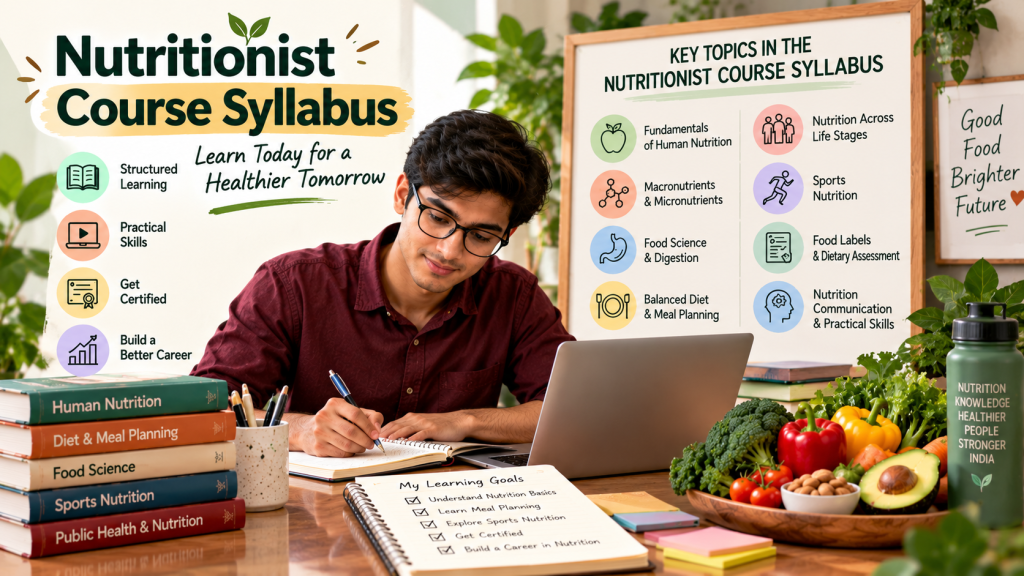
Choosing the right nutrition course begins with understanding what you will study. A detailed Nutritionist Course Syllabus helps you evaluate the subjects, learning outcomes, practical skills, and educational value of a programme before enrolling.
For students, fitness enthusiasts, and working professionals in India, nutrition education can provide a foundation for understanding food, dietary habits, and healthy lifestyle choices. However, different courses cover different topics, and the depth of learning depends on the institution and qualification.
If you are exploring online study options, start by reviewing the Nutritionist Course Online page at Institute Nutrition. Understanding the available programme information alongside a typical syllabus can help you decide whether the course matches your learning goals.
This guide explains the major subjects commonly included in nutrition education, the skills learners may develop, and what to check before choosing a course.
What Is a Nutritionist Course Syllabus?
A Nutritionist Course Syllabus is a structured outline of the subjects, modules, learning objectives, and assessments included in a nutrition education programme.
It helps students understand what they will learn, how the course progresses, and which topics receive the most attention.
Depending on the programme, the syllabus may cover:
- Fundamentals of human nutrition.
- Macronutrients and micronutrients.
- Food science and digestion.
- Balanced diets and meal planning.
- Nutrition across different life stages.
- Food labels and dietary assessment.
- Introduction to sports nutrition.
- Nutrition communication and ethical practice.
A beginner-level course may focus on foundational knowledge, while an advanced academic programme may include more detailed scientific study and supervised practical learning.
When reviewing a Nutritionist Course Syllabus, remember that the list of subjects alone does not establish the quality or professional recognition of a programme. You should also evaluate the teaching methods, instructor qualifications, assessments, and certificate details.
Why Should You Check the Nutritionist Course Syllabus Before Enrolling?
Selecting a course without reviewing its syllabus can lead to mismatched expectations. A programme might sound attractive but may not cover the subjects you actually want to study.
Reviewing the Nutritionist Course Syllabus helps you answer several important questions.
Does the course match your current knowledge? Beginners may need an introduction to basic nutrition concepts before moving into more specialised subjects.
Does it support your goals? Someone interested in general nutrition education may need a different curriculum from someone planning to pursue sports nutrition or further academic study.
Does it include practical learning? Assignments, case studies, food-label activities, and assessments can help learners apply theoretical concepts.
Are the learning outcomes clearly explained? The institution should state what learners can reasonably expect to understand after completing the programme.
For students in India, it can also be helpful to check whether examples reflect familiar foods, regional dietary patterns, and everyday meal-planning situations.
Core Subjects in a Nutritionist Course Syllabus
The following subjects commonly appear in nutrition education. The exact modules and depth will vary by institution, so use this outline as a comparison guide rather than an official syllabus for any particular course.
1. Fundamentals of Human Nutrition
Human nutrition is often one of the first subjects students encounter. It introduces the relationship between food, nutrients, and normal body functions.
Learners may explore:
- The meaning and importance of nutrition.
- Essential nutrients and their functions.
- The relationship between diet and wellbeing.
- Factors that influence dietary choices.
- Basic principles of a balanced diet.
This foundation helps students understand later subjects more effectively.
A good Nutritionist Course Syllabus should explain these concepts clearly and distinguish established nutrition principles from unsupported dietary claims.
2. Macronutrients and Micronutrients
Nutrients are commonly grouped into macronutrients and micronutrients.
Macronutrients include carbohydrates, proteins, and fats. Micronutrients include vitamins and minerals. Water is also essential for normal body functions.
A syllabus may introduce the following topics:
- Food sources of carbohydrates, proteins, and fats.
- The functions of different nutrients.
- Vitamins and minerals.
- Nutrient requirements and dietary variety.
- The importance of adequate nutrient intake.
Understanding these concepts helps learners evaluate food choices more accurately rather than focusing on a single nutrient or following restrictive food rules without context.
3. Food Science and Digestion
Food science explores the properties of food, while digestion involves the processes through which the body breaks down and absorbs nutrients.
Depending on the course level, students may study:
- Basic digestive system functions.
- Digestion and nutrient absorption.
- Food composition.
- Food preparation and nutrient retention.
- Food storage and safety principles.
These subjects help connect the foods people eat with the processes involved in using nutrients.
Advanced programmes may cover these topics in greater scientific detail than introductory certificate courses.
4. Balanced Diet and Meal Planning
Meal planning is an important topic for learners who want to understand how different foods can contribute to a varied dietary pattern.
A Nutritionist Course Syllabus may introduce:
- Food groups and dietary variety.
- Portion sizes and meal structure.
- Meal planning principles.
- Dietary preferences and restrictions.
- Factors affecting food choices.
- Basic approaches to evaluating a meal plan.
In India, practical examples may include familiar meals such as idli and sambar, rice and dal, roti with vegetables, curd, eggs, fish, or other locally available foods.
The goal is to understand how different foods contribute to a dietary pattern rather than assume that one meal plan suits everyone.
5. Nutrition Across Different Life Stages
Nutritional needs can change with age, growth, physical activity, and individual circumstances.
A course may introduce general nutrition considerations for:
- Children and adolescents.
- Adults.
- Older adults.
- Pregnancy and breastfeeding.
The depth of coverage varies. Introductory programmes may explain general principles, while specialised academic education may cover more complex nutritional requirements.
Students should understand that general nutrition education does not automatically qualify them to provide individualised clinical care or manage medical conditions.
6. Food Labels and Dietary Assessment
Food labels help consumers understand product ingredients, serving sizes, energy, and nutrient content.
A syllabus may teach students how to read nutrition panels, compare products, and evaluate common marketing claims.
Dietary assessment may also be introduced, including basic methods of recording food intake and identifying patterns in eating habits.
These skills are relevant to everyday food decisions in India, where consumers encounter a wide range of packaged foods, snacks, beverages, and nutrition products.
When comparing a Nutritionist Course Syllabus with another programme, check whether food-label interpretation and dietary assessment are included and how thoroughly they are taught.
7. Introduction to Sports Nutrition
Some nutrition courses introduce the relationship between nutrition, exercise, hydration, and recovery.
Possible topics include:
- Energy needs and physical activity.
- Protein and muscle recovery fundamentals.
- Hydration principles.
- Nutrition before and after exercise.
- Introduction to sports performance nutrition.
This subject may interest fitness enthusiasts and people considering further study in sports nutrition.
However, an introductory module should not be mistaken for specialist sports nutrition training. Check the programme’s depth and the qualifications required for the role you want to pursue.
8. Healthy Lifestyle and Nutrition Communication
Nutrition education also involves communicating information responsibly.
A course may introduce the relationship between eating habits, physical activity, sleep, and general wellbeing. It may also discuss how to explain basic nutrition concepts clearly to different audiences.
Useful skills can include evaluating sources, recognising misleading claims, and understanding why individual needs differ.
These subjects are especially relevant when sharing nutrition information online, where unsupported health advice can spread quickly.
Practical Skills You May Develop During Nutrition Training
A syllabus should explain not only what you will study but also what you will be able to do with that knowledge.
Depending on the course, practical learning may involve:
Reading food labels: Understanding serving sizes, ingredients, and nutrient information.
Evaluating meal patterns: Identifying food variety and considering whether a meal includes different food groups.
Understanding dietary records: Learning how food-intake information can be collected and interpreted for educational purposes.
Assessing nutrition information: Checking whether claims are supported by credible evidence.
Communicating basic concepts: Explaining general nutrition principles in clear, accessible language.
A strong Nutritionist Course Syllabus should describe how these skills are taught and assessed.
Practical exercises should also be appropriate to the student’s training level. They should not imply that someone without the required professional qualifications can diagnose conditions or prescribe therapeutic diets.
How Does a Nutritionist Course Syllabus Apply to Indian Food Habits?
India’s regional food traditions make nutrition education particularly interesting. Dietary patterns can differ considerably between states, communities, and households.
For example, students may explore how rice, pulses, vegetables, dairy products, eggs, fish, fruits, and other foods contribute to different eating patterns.
A practical Nutritionist Course Syllabus may use familiar foods to explain nutrient sources, meal variety, and food-label interpretation.
Learners can also consider everyday challenges such as limited preparation time, food budgets, vegetarian dietary preferences, eating away from home, and differences in household routines.
These examples help connect theoretical concepts with everyday decisions. They should not be used to prescribe the same dietary approach to every individual, because nutritional needs and circumstances vary.
For learners in Chennai, Bengaluru, Mumbai, Delhi, and other Indian cities, online nutrition education can offer a convenient way to explore these subjects without necessarily relocating for classroom-based study.
What Is the Difference Between a Basic and an Advanced Nutrition Syllabus?
Not all nutrition courses are designed for the same purpose.
| Feature | Basic nutrition course | Advanced nutrition programme |
|---|---|---|
| Main focus | Foundational nutrition concepts | More specialised or detailed study |
| Subjects | Nutrients, food groups, balanced eating | May include advanced scientific or applied subjects |
| Assessments | Quizzes, assignments, or basic examinations | May involve more extensive assessments or practical work |
| Entry requirements | May be suitable for beginners | May require prior education or specific eligibility |
| Professional relevance | Depends on the course and intended use | Depends on the qualification, recognition, and requirements of the role |
The Nutritionist Course Syllabus should be evaluated according to the level of study rather than the number of topics listed.
A short course can be useful for foundational learning, but a longer list of modules does not automatically mean that a programme is academically stronger or professionally recognised.
How to Evaluate the Quality of a Nutrition Course
After reviewing the syllabus, examine the programme as a whole.
Check the Institution and Instructors
Review the institution’s information and the relevant qualifications of its teaching staff. Look for clear explanations of the course structure and learning outcomes.
Verify the Certificate
Confirm who issues the certificate and whether any claimed accreditation or affiliation can be independently verified.
A certificate of completion does not necessarily represent a university qualification or professional registration.
Review the Assessment Process
Check whether learners complete quizzes, assignments, examinations, or practical activities. Assessments should align with the stated learning outcomes.
Understand the Career Limitations
If you want to work in clinical nutrition or dietetics, research the specific academic and professional requirements applicable to that role in India.
Do not assume that completing an online nutrition course automatically qualifies you to practise in a regulated or specialised healthcare position.
Compare Fees and Learning Support
Check the full fee, course duration, access to learning materials, and available student support.
A suitable programme should offer transparent information so that you can make an informed decision before enrolling.
Learn From Nutrition Professionals and Industry Resources
Formal coursework can be complemented by credible educational resources that explain how nutrition principles are discussed in practical settings.
For example, Ryan Fernando’s official website shares information about personalised nutrition, sports performance, and nutrition-related services. Exploring resources like these can provide additional context for learners interested in how nutrition knowledge is applied in everyday and athletic settings.
Use such resources alongside structured coursework and reliable educational material. An expert website is a supplementary learning resource, not a replacement for an academic qualification or formal professional training.
When evaluating nutrition advice, consider whether it is evidence-based, whether it recognises individual differences, and whether the source has relevant expertise.
This habit can help students develop a more careful and responsible approach to nutrition information.
Explore Nutrition Courses at Institute Nutrition
If you are comparing programmes, Institute Nutrition provides course information that you can review before deciding which option fits your learning goals.
Start by exploring the Nutritionist Course Online page. Review the available information and compare it with the subjects and learning outcomes you expect from your chosen programme.
Before enrolling, check the syllabus, course format, eligibility criteria, fees, assessment methods, certificate details, and available learner support.
If your goal is further academic study or a specialised professional role, confirm whether the course meets the relevant entry or qualification requirements.
Frequently Asked Questions
1. What does a Nutritionist Course Syllabus include?
A Nutritionist Course Syllabus may include human nutrition, nutrients, balanced diets, meal planning, food labels, nutrition across different life stages, and introductory sports nutrition. The exact topics depend on the institution and programme level.
2. Is nutrition a difficult subject to study?
The difficulty depends on your background and the course level. Introductory programmes generally begin with basic concepts, while advanced study may require more detailed scientific understanding and assessments.
3. How can I check whether a syllabus is suitable for beginners?
Look for introductory modules, clearly explained learning outcomes, stated entry requirements, and an assessment structure that matches your existing knowledge.
4. Does every nutrition course include sports nutrition?
No. Sports nutrition may be included as an introductory module or offered as a separate specialisation. Check the syllabus before enrolling if this subject is important to your goals.
5. Does completing a nutrition certificate qualify me to become a dietitian?
Not automatically. Dietetics and clinical nutrition roles may require specific academic qualifications, practical training, or other professional credentials. Verify the applicable requirements before choosing a programme.
6. Can I study nutrition online in India?
Yes, many institutions provide online nutrition education. Compare the course structure, instructor support, syllabus, fees, and certificate information before enrolling.
7. Where can I review a nutrition course programme?
You can visit the Institute Nutritionist Course Online page to explore the available course information.
Conclusion
Understanding the Nutritionist Course Syllabus is an important step towards choosing a programme that matches your educational goals. It helps you compare subjects, learning outcomes, practical activities, and the overall structure of a course before committing your time and money.
Look for transparent course information, credible instruction, relevant assessments, and clear certificate details. If you intend to pursue a specialised professional role, confirm that the qualification meets the requirements for that pathway.
To explore another learning option, review the Nutrition Certification Course at Institute Nutrition and compare its available programme information with your learning objectives.