Nutrition is becoming an important part of conversations about fitness, preventive healthcare, sports performance, and everyday wellbeing. As more people pay attention to what they eat, many students and working professionals are exploring opportunities to develop their knowledge of nutrition. A Certified Nutritionist Course Online can be a practical starting point for anyone who wants to understand nutrition principles and explore a career in this field.
Whether you are a recent graduate, a fitness enthusiast, a healthcare professional, or someone considering a career change, online learning offers flexibility and access to structured educational resources. However, choosing the right programme requires more than comparing fees or looking at the certificate offered at the end.
This guide explains what to look for in a Certified Nutritionist Course Online, the subjects you may study, the benefits of online learning, and the important factors to consider before enrolling in India.
What Is a Certified Nutritionist Course Online?
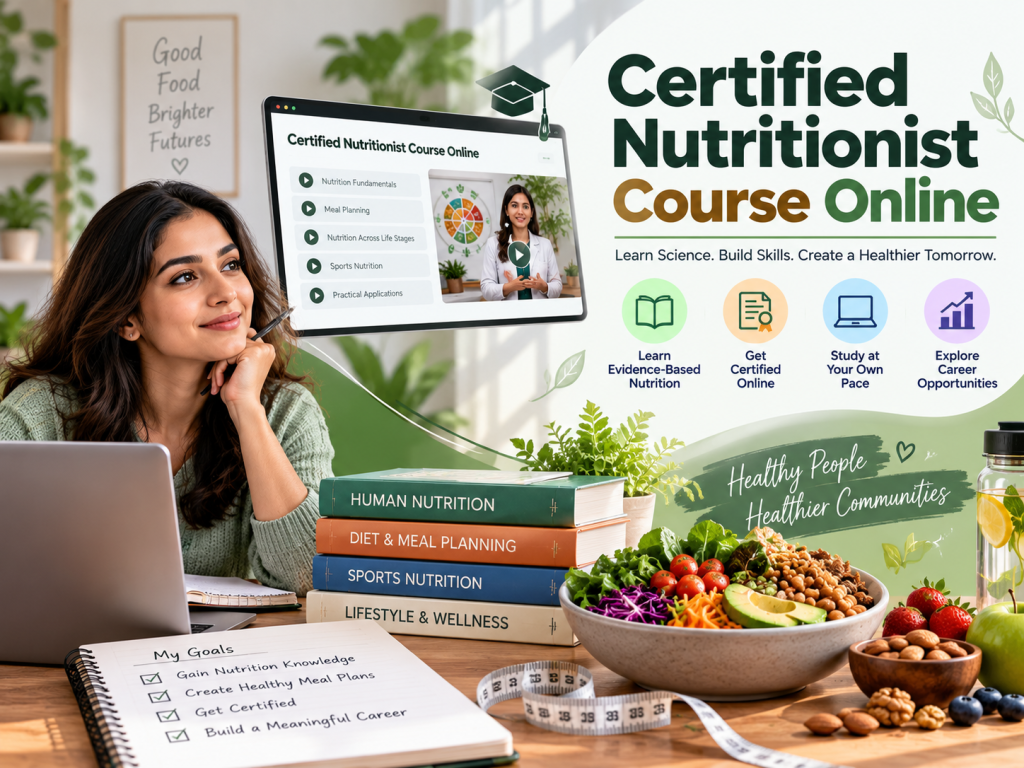
A Certified Nutritionist Course Online is an educational programme that introduces learners to nutrition science, healthy eating principles, dietary planning, and the relationship between food and wellbeing. Depending on the curriculum, it may also cover nutrition across different life stages, sports nutrition, food labels, and practical approaches to balanced diets.
Online programmes allow learners to access lessons digitally rather than attending every session at a physical institution. Some offer recorded classes, while others may include live sessions, assessments, assignments, or instructor support.
Before choosing a Certified Nutritionist Course Online, understand what the course actually teaches and what the certificate represents. A course completion certificate is not automatically equivalent to a university qualification, professional licence, or recognised clinical credential.
For this reason, students should check the programme’s curriculum, faculty, assessment methods, accreditation claims, and eligibility requirements before making a decision.
Why Are More Indians Exploring Online Nutrition Education?
India has a diverse food culture, with eating habits shaped by regional traditions, family routines, affordability, and lifestyle. From idli and sambar in South India to roti, dal, and vegetables in North India, everyday meals can look very different from one household to another.
Understanding nutrition in this context means learning how food choices, portion sizes, dietary variety, and individual needs influence overall dietary quality.
An online nutrition programme can help learners build a foundation in these subjects while studying at their own pace. It can also be useful for people balancing education with employment, family responsibilities, or other commitments.
A Certified Nutritionist Course Online may be worth exploring if you want to:
- Understand the fundamentals of human nutrition.
- Learn about balanced diets and practical meal planning.
- Develop a stronger foundation in food and nutrition.
- Explore further education in nutrition-related fields.
- Add relevant knowledge to an existing fitness or wellness background.
- Investigate potential career paths before committing to advanced study.
The right programme should connect scientific concepts with everyday food decisions rather than relying only on general advice or popular diet trends.
What Will You Learn in a Certified Nutritionist Course Online?
Course content varies between providers, so review the syllabus before enrolling. A well-structured programme may cover several important areas.
1. Fundamentals of Human Nutrition
Learners are introduced to macronutrients and micronutrients, including carbohydrates, proteins, fats, vitamins, and minerals. You may study their functions, common food sources, and roles in maintaining normal body functions.
Understanding these basics helps learners interpret nutrition information more carefully and distinguish established principles from misleading dietary claims.
2. Balanced Diets and Meal Planning
Meal planning involves more than counting calories. It requires considering dietary variety, food preferences, portion sizes, affordability, activity levels, and individual circumstances.
In the Indian context, this may involve understanding how different combinations of cereals, pulses, dairy products, vegetables, fruits, nuts, and other foods contribute to a varied diet.
3. Nutrition Across Different Life Stages
Nutritional needs change throughout life. A course may introduce the dietary considerations associated with childhood, adolescence, adulthood, pregnancy, and older age.
Learners should understand that general nutrition education has limits. Individual medical needs may require assessment and guidance from appropriately qualified healthcare professionals.
4. Food Labels and Nutrition Information
Food labels provide information about ingredients, serving sizes, energy, and nutrient content. Learning to read them can help consumers compare products and make informed choices.
A nutrition programme may introduce label interpretation, common marketing claims, and ways to evaluate nutrition information critically.
5. Lifestyle, Fitness, and Sports Nutrition
Some programmes introduce the relationship between nutrition, physical activity, hydration, exercise recovery, and sports performance.
If you are interested in working in fitness or sports-related environments, check whether the course provides sufficient depth for your intended role. A general nutrition certificate may not provide the specialist training needed for advanced sports nutrition practice.
How to Choose the Right Certified Nutritionist Course Online
Choosing a course is an investment of both time and money. Instead of enrolling based only on promotional claims, evaluate the programme against your educational goals.
Check the Curriculum in Detail
Look for a syllabus that clearly explains the modules, learning outcomes, assessments, and practical activities. The course should tell you what you will learn and how your understanding will be evaluated.
Avoid relying on a course title alone. Two programmes with similar names can have very different academic depth and professional relevance.
Review the Faculty and Learning Support
Find out who teaches the course and what relevant educational or professional experience they have. Check whether students can ask questions, receive feedback, and access support when they need help understanding difficult concepts.
Reliable teaching and transparent course information are more useful than unsupported claims about guaranteed career success.
Verify the Certificate and Recognition
The word certified can mean different things depending on the provider. Before enrolling, confirm who issues the certificate, whether the programme is affiliated with a recognised institution, and whether any accreditation claim can be independently verified.
A certificate may demonstrate that you completed a particular course, but it does not necessarily qualify you to diagnose medical conditions, prescribe therapeutic diets, or practise in a regulated healthcare role.
If you intend to work in clinical nutrition or dietetics, check the qualifications and professional requirements applicable to your intended role in India.
Compare Fees, Duration, and Flexibility
Review the complete fee structure, including any examination charges, additional materials, or certificate fees. Consider how long you will have access to the learning materials and whether you can study around your existing schedule.
The cheapest programme is not always the best value, and a more expensive programme is not automatically more credible. Compare the actual learning outcomes and support provided.
Understand the Career Relevance
Think about why you want to study nutrition. You might be interested in wellness education, fitness, sports nutrition, further academic study, or personal knowledge.
Choose a course that matches your intended direction. If your goal requires a formal academic qualification or professional registration, confirm that the programme meets those requirements before paying.
Who Should Consider a Certified Nutritionist Course Online?
An online course can suit learners with different backgrounds, provided they understand its scope and entry requirements.
Students and recent graduates: You may use introductory nutrition education to explore a subject that interests you before pursuing further study.
Fitness trainers and wellness professionals: Nutrition knowledge can complement existing work, subject to your professional scope and the limits of your qualifications.
Working professionals: Flexible online lessons can help you develop knowledge without immediately leaving your current job.
Career changers: A structured course can help you investigate whether nutrition is a suitable long-term direction before committing to a larger educational investment.
People interested in healthy eating: You may simply want to understand food choices, dietary variety, and nutrition information more confidently.
A Certified Nutritionist Course Online should be selected according to your current knowledge, future plans, and the level of professional responsibility you hope to take on.
Learning from Nutrition Professionals and Industry Resources
Formal education is an important starting point, but continuing to learn from credible nutrition resources can help you develop a broader understanding of the field.
For example, Ryan Fernando’s official website shares information about personalised nutrition, sports performance, and practical approaches to health and wellbeing. Exploring resources like these can help learners see how nutrition principles are discussed in real-world settings.
Use such resources to complement your studies, not to replace a structured syllabus or evidence-based academic learning. When reading nutrition advice online, consider the source, the evidence behind the recommendation, and whether the information is relevant to the specific population being discussed.
A useful learning habit is to compare public nutrition advice with reliable educational materials and established dietary guidance. This encourages critical thinking rather than accepting every popular food or diet claim at face value.
Is an Online Nutrition Certificate Enough to Become a Professional Nutritionist?
This is one of the most important questions to ask before enrolling.
The answer depends on the course, the role you want, and the qualifications required for that role. Some short courses are designed for general education, while others form part of broader professional development or academic pathways.
Completing a Certified Nutritionist Course Online does not automatically establish eligibility for every nutrition-related profession. Clinical roles, dietetics, and work involving medical nutrition care may require additional formal education, supervised experience, or other recognised qualifications.
Before choosing a programme, consider the job descriptions for the positions you hope to pursue. Look at the qualifications employers request and verify whether the course you are considering meets those expectations.
This simple step can help you avoid investing in a programme that does not support your intended career path.
Why Choose Institute Nutrition for Your Nutrition Learning Journey?
If you are comparing programmes, explore the course information provided by Institute Nutrition to understand the learning options available.
Visit the Nutrition Certification Course page to review the programme details and determine whether it aligns with your educational goals.
Before enrolling, examine the curriculum, course format, eligibility criteria, fees, certificate information, and available learner support. If anything is unclear, contact the institution for clarification.
The best learning decision is an informed one. Take the time to understand what a programme offers, what you can reasonably expect to gain, and whether additional qualifications will be necessary for your future plans.
Frequently Asked Questions
1. What is a Certified Nutritionist Course Online?
A Certified Nutritionist Course Online is a digital learning programme that teaches nutrition-related concepts. Its depth, duration, assessment methods, and certificate recognition depend on the provider.
2. Can beginners enrol in a Certified Nutritionist Course Online?
Some programmes are designed for beginners and may not require previous nutrition education. Others have specific academic or professional entry requirements. Always review the eligibility criteria before applying.
3. How long does an online nutrition certification take?
The duration varies by programme. Short introductory courses may take less time than comprehensive programmes with assignments, examinations, or practical learning components. Check the provider’s stated duration and study requirements.
4. Can I study nutrition while working full-time?
Yes, many online programmes offer flexible learning schedules. However, the workload, attendance requirements, live classes, and assessment deadlines differ between providers.
5. Does an online certificate qualify me to become a clinical nutritionist?
Not necessarily. Clinical nutrition and related healthcare roles may require additional recognised qualifications, practical training, or professional credentials. Verify the requirements for your intended role before enrolling.
6. What should I check before paying for a course?
Review the syllabus, instructor qualifications, course fees, learning support, assessment process, certificate issuer, accreditation claims, and relevance to your career goals.
7. Where can I learn more about the available programme?
Visit the Institute Nutrition Nutrition Certification Course page to review the available course information and contact the institution if you need clarification.
Final Thoughts
Nutrition education can open the door to a deeper understanding of food, dietary habits, and wellbeing. However, selecting the right programme requires careful consideration of your goals, the curriculum, and the qualifications needed for your intended career.
A Certified Nutritionist Course Online can be a useful starting point when its learning outcomes match your needs and its credentials are clearly explained. Compare your options, look for evidence-based teaching, and avoid making decisions based solely on promises of quick certification or guaranteed employment.
If you are ready to explore your options, visit Institute Nutrition’s Nutrition Certification Course page and review the programme details before taking the next step in your nutrition education journey.